

Why Your Business Isn’t Ranking in Perth (And How to Fix It)
Top 10 reasons your Perth business isn't ranking
Local SEO fix guide — based on Google's own guidelines
Google Business Profile missing
Unclaimed = invisible in Google Maps & Local Pack results
Too few quality backlinks
One link from a Perth news site beats 50 low-quality links
No location signals on website
No Perth, no suburbs — Google can't connect you to local searches
Content misses search intent
A brochure page won't rank. Helpful content does
Technical SEO problems
Slow speed, broken links, no SSL, not mobile-friendly
Inconsistent NAP listings
Different name, address or phone across directories = trust problem
Not collecting Google reviews
87% of customers read reviews before choosing a business
Expecting results too fast
Top-ranked pages average over 2 years old — Ahrefs research
Wrong keyword strategy
Broad terms lose to national brands. Target suburb-level keywords
No tracking or analytics
Without Search Console + GA4, you are guessing — and losing
of local searchers visit a business within 24 hours — Google
of customers read reviews before choosing a business — BrightLocal
of websites have at least one technical SEO issue — Semrush
You built a great website. You wrote some content. You even Googled your own business name — and nothing. Not on page one. Not on page two. Barely anywhere.
If you’re a Perth business owner, this is frustratingly common. And before you blame your web developer or throw your laptop into the Swan River, let’s talk about what’s actually going on.
Perth has a growing, competitive digital market. According to Google’s own research, 76% of people who search for something nearby on their phone visit a business within a day. That means local SEO isn’t optional anymore — it’s survival.
This guide breaks down the real reasons your Perth business isn’t showing up on Google, and more importantly, what you can do about it today.
1. You Haven’t Set Up (or Optimised) Your Google Business Profile
Let’s start with the most common culprit. If your Google Business Profile (formerly Google My Business) is incomplete, unverified, or missing entirely — you’re essentially invisible in local search.
Google uses your Business Profile to populate the Local Pack — that box of three businesses that appears right below the map when someone searches ‘plumber Perth’ or ‘café near me.’ If you’re not in there, your competitors are.
What you need to fix:
- Claim and verify your Google Business Profile at business.google.com
- Fill in every section — name, address, phone, website, opening hours, categories
- Add high-quality photos of your business (Google says profiles with photos get 42% more direction requests)
- Choose the right primary and secondary business categories
- Write a clear, keyword-rich business description
- Set up your Q&A section with common customer questions
One more thing — if your business name, address, and phone number (NAP) don’t match exactly across Google, your website, and other directories like True Local or Yellow Pages, Google gets confused. And a confused Google doesn’t rank you.
2. Your Website Isn’t Telling Google Where You Are
Here’s a scenario: someone searches ’emergency electrician Perth’ and your website just says ‘we provide electrical services.’ No mention of Perth. No suburb names. No local context.
Google’s algorithm is smart, but it still needs signals. If your website doesn’t clearly communicate that you serve Perth — and specifically which suburbs — you won’t rank for local searches.
On-page SEO fixes for Perth businesses:
- Include your city and suburb in your page title tags (e.g., “Plumber in Subiaco, Perth | YourBrandName”)
- Add your location in the H1 heading of your homepage and service pages
- Mention Perth and relevant suburbs naturally throughout your content
- Create a dedicated Contact page with a full street address, embedded Google Map, and local phone number
- Add LocalBusiness schema markup to your website’s code — this tells search engines exactly what you do and where
Schema markup sounds technical, but tools like Google’s Rich Results Test (search.google.com/test/rich-results) let you check if your site is already using it correctly.
3. You’re Ignoring Technical SEO Issues
Technical SEO isn’t glamorous. Nobody posts Instagram reels about fixing crawl errors. But if Google can’t properly read and index your website, nothing else matters.
According to a study by Semrush, over 80% of websites have at least one technical SEO issue. Common problems that kill Perth business rankings include:
- Slow page load speeds — Google officially uses page speed as a ranking factor (check yours with PageSpeed Insights)
- Your website isn’t mobile-friendly — Google uses mobile-first indexing, meaning it primarily looks at your mobile site
- Broken links and 404 errors — these signal a poorly maintained site
- Duplicate content — having the same text on multiple pages confuses Google
- Missing or poorly written meta descriptions and title tags
- No SSL certificate — if your site shows “Not Secure,” users and Google both notice
Run your site through Google Search Console (a free tool). It shows you exactly what technical problems Google has found. Fix those first before spending money on anything else.
4. You’re Not Getting (or Responding to) Reviews
Reviews are one of the most powerful local ranking signals — and most Perth businesses massively underestimate them.
Think about it from Google’s perspective: if two landscaping businesses in Fremantle are otherwise equal, Google is going to show the one with 47 five-star reviews over the one with two. Because that’s what users prefer.
A study by BrightLocal found that 87% of consumers read online reviews for local businesses. More reviews, more trust, more clicks, better rankings. It’s a virtuous cycle.
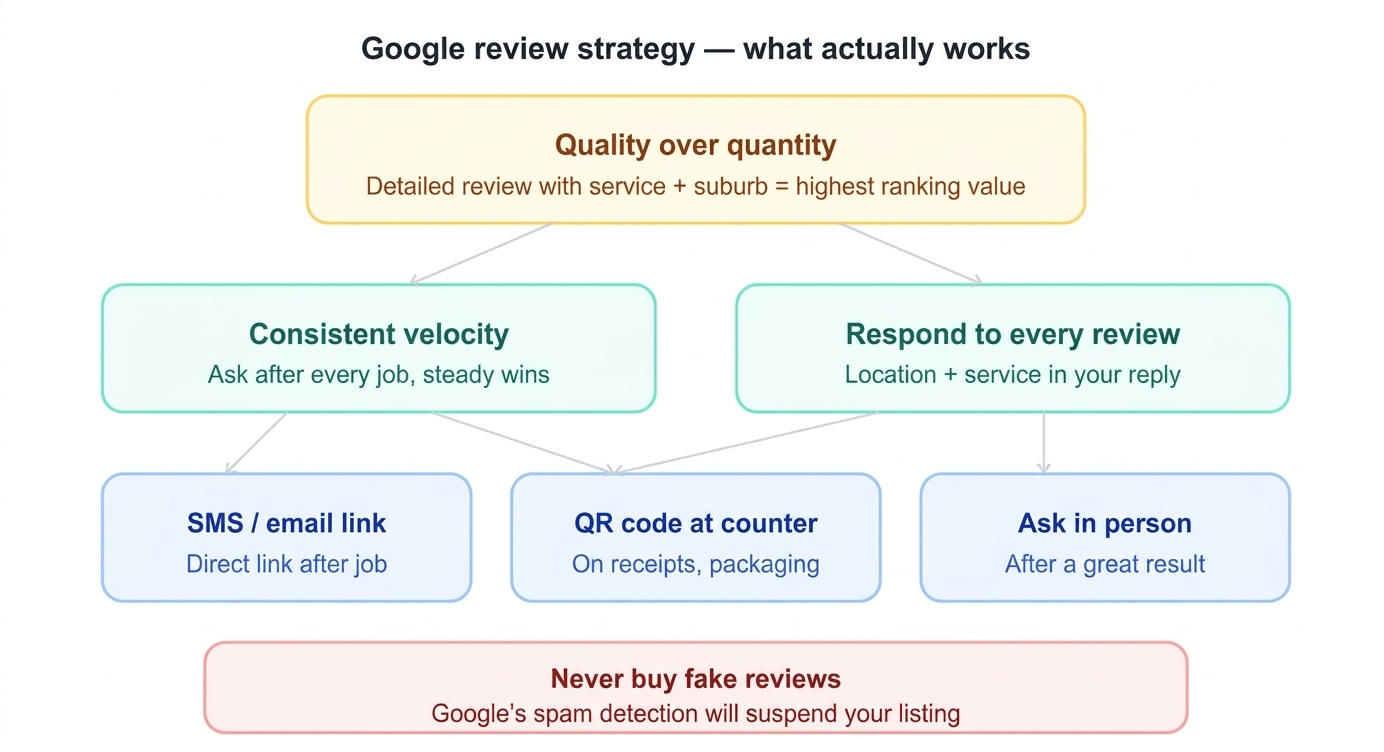
A simple review strategy that works:
- Ask every happy customer for a review — most won’t think to do it unless you ask
- Send a follow-up email or SMS with a direct link to your Google review page
- Respond to every review — positive and negative — professionally and promptly
- Never buy fake reviews. Google is very good at detecting them, and the penalty isn’t worth it
Responding to negative reviews, by the way, is not optional. A business that professionally handles criticism actually builds more trust than one with nothing but perfect scores.
5. Your Keyword Strategy Is Off
You might be optimising for the wrong keywords — or not doing keyword research at all.
A lot of Perth businesses make the mistake of targeting very broad terms like ‘marketing’ or ‘plumbing.’ These are dominated by massive national brands with enormous domain authority and advertising budgets. You’re not going to beat Seek or Hipages for generic terms as a small local business.
Instead, focus on specific, local, intent-driven keywords.
Keyword research tips for Perth businesses:
- Use Google’s free Keyword Planner or tools like Ubersuggest to find realistic terms
- Target suburb-level keywords like “accountant in Joondalup” or “hair salon Cottesloe”
- Focus on long-tail keywords — phrases of 3–5 words that show clear intent
- Look at what your competitors rank for using free tools like Moz or Ahrefs (limited free use)
- Don’t stuff keywords — Google’s Helpful Content guidelines explicitly penalise keyword-stuffed, low-quality pages
Google’s own documentation on Search Essentials (formerly Webmaster Guidelines) states clearly: focus on creating content for people first, and let SEO be secondary. That’s not a platitude — it’s the actual algorithm direction since the 2022 Helpful Content Update.
6. You Don’t Have Enough Quality Backlinks
A backlink is when another website links to yours. Think of it as a vote of confidence. Google still uses backlinks as a core ranking signal — this hasn’t changed despite years of algorithm updates.
But here’s what most people get wrong: it’s quality over quantity. One link from a reputable Perth news site or industry directory is worth more than 50 links from random, low-quality blogs.
Legitimate ways to earn backlinks as a Perth business:
- Get listed in credible local directories: True Local, Yellow Pages Australia, Hotfrog, and your local Chamber of Commerce
- Reach out to Perth-based bloggers or local media for features or mentions
- Write genuinely useful content that others in your industry want to reference
- Sponsor local events or community groups — these often include website links
- Partner with complementary local businesses for mutual linking opportunities
Avoid black-hat link schemes. Google’s SpamBrain system — its AI-powered spam detection — has become very effective at identifying unnatural link patterns. Getting caught can result in your site being manually penalised or deindexed entirely.
7. Your Content Isn’t Answering What Perth Customers Actually Ask
Content is still king — but only if it’s useful content. A lot of Perth business websites have a Services page that basically says ‘we do this, we do that, call us.’ That’s not content. That’s a brochure.
Google’s algorithms — particularly the Helpful Content system introduced in 2022 and updated in 2023 — are increasingly able to judge whether a page genuinely helps a user or just exists to rank. The latter gets demoted.
A content strategy that works for local Perth businesses:
- Write a blog or resource section that answers common customer questions
- Cover Perth-specific topics — local regulations, seasonal tips relevant to WA, suburb-specific guides
- Create separate landing pages for each major suburb you serve
- Use FAQ sections on key pages — these often appear in Google’s People Also Ask boxes
- Keep content updated — outdated pages signal a stale, low-trust site
Short, clear paragraphs work best — both for readers and for AI-powered search features like Google’s Search Generative Experience (SGE), which pulls structured, helpful content into answers.
8. You’re Not Consistent Across Local Directories
This one is underrated. Your business is listed on five different directories, but your phone number is slightly different on each one, and your address is formatted three different ways. This inconsistency damages your local search credibility.
Google uses citation signals — mentions of your business across the web — to verify you’re a real, established local business. Inconsistency in your NAP (Name, Address, Phone) data creates doubt.
Perth-relevant local directories to audit and update:
- Google Business Profile
- Bing Places for Business
- Yellow Pages Australia (yellowpages.com.au)
- True Local
- Hotfrog
- Yelp Australia
- Local Chamber of Commerce listings
- Industry-specific directories relevant to your niche
Use a tool like BrightLocal’s Citation Tracker or Whitespark to audit your existing citations and spot inconsistencies.
9. You’re Expecting Results Too Quickly
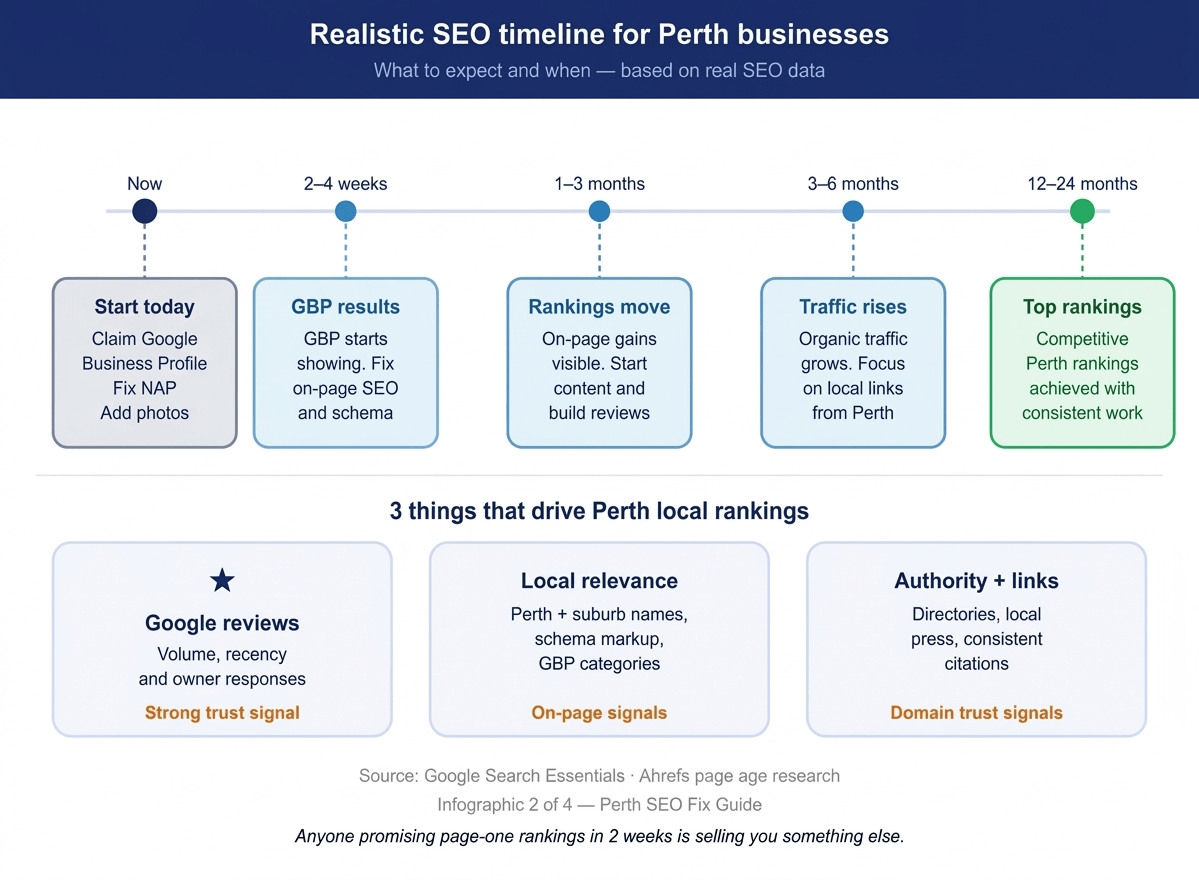
This might be the hardest truth in this entire guide: SEO takes time. Real, sustainable SEO is not a two-week project.
Google itself states in its documentation that SEO improvements can take “several months” to show results. Independent studies — including research from Ahrefs — suggest that pages ranking in the top ten on Google are on average over two years old.
That doesn’t mean you should wait two years to start. It means you should start now, be consistent, and measure your progress realistically.
Realistic SEO timelines for Perth businesses:
- Google Business Profile optimisation: results visible within 2–4 weeks
- On-page SEO improvements: 1–3 months to see movement
- Content marketing: 3–6 months for consistent traffic
- Link building: 6–12 months for meaningful domain authority growth
- Full competitive rankings in a tough Perth niche: 12–24 months
Anyone promising you page-one rankings in two weeks is either selling you paid ads (which stop the moment you stop paying) or selling you something you don’t want to buy.
10. You Haven’t Connected Google Search Console or Analytics
If you’re not measuring, you’re guessing. And guessing is expensive.
Google Search Console is free. Google Analytics 4 is free. Both are straightforward to set up and give you data that’s genuinely useful — what keywords people use to find you, which pages get the most traffic, which devices users are on, and where you’re losing potential customers.
Set these up now if you haven’t:
- Google Search Console — search.google.com/search-console
- Google Analytics 4 — analytics.google.com
- Connect both tools so your data talks to each other
- Set up a Google Business Profile Insights dashboard to track calls, direction requests, and profile views
These tools don’t just show you what’s working — they show you what’s broken. And fixing what’s broken is always faster than guessing what to build next.
Quick-Fix Priority Checklist for Perth Businesses
Here’s a practical order of priority — start at the top and work your way down:
- Claim and fully complete your Google Business Profile
- Ensure your NAP is consistent across all directories
- Fix technical issues flagged in Google Search Console
- Add local keywords and suburb names to your key pages
- Add LocalBusiness schema markup to your website
- Start a review generation process with happy customers
- Publish helpful, locally-relevant content monthly
- Build quality backlinks from Perth-based sources
- Track progress monthly in Search Console and Analytics
Final Word: Perth SEO Is a Long Game Worth Playing
There’s no magic button. No secret hack. No shortcut that Google hasn’t already figured out and penalised.
What works is consistent, honest effort: a properly set-up Business Profile, a technically sound website, content that genuinely helps your customers, and a steady stream of citations, backlinks, and reviews.
Perth is a city where local trust matters. People here would rather call a local business they’ve heard of than a faceless national brand. SEO is how you become that known local business — even for people who’ve never met you yet.
Start with the basics. Be consistent. Measure what works. And if you’re not sure where your site stands right now, run it through Google Search Console and Google’s PageSpeed Insights — both free, both honest, and both more useful than any guesswork.
The businesses ranking on page one in Perth aren’t there by accident. They followed a process. Now you have that process too.
Frequently Asked Questions

Contact The Creative Warrior Team
Recent Posts

How to choose an SEO agency for small business
Website Design Trends 2026: What Small Businesses Should Know Choosing [...]

Search Engine Optimization Services for Small Business
Website Design Trends 2026: What Small Businesses Should Know Small [...]

How Google Reviews Help Tradies Win More Jobs
Website Design Trends 2026: What Small Businesses Should Know Many [...]

Why Word-of-Mouth Isn’t Enough for Perth Tradies in 2026
Website Design Trends 2026: What Small Businesses Should Know For [...]

How To Contact Facebook Business Support for Help
Your personal Facebook profile must have full admin access to a Meta Business Account [...]

How Local SEO Helps Perth Businesses Generate Consistent Leads
Website Design Trends 2026: What Small Businesses Should Know In an [...]

AI Visibility Isn’t About Content — It’s About Citations
To show up in AI summaries, you must be cited by sources AI already [...]

How to Complete Your Google Business Video Verification (Without Losing Your Mind)
If Google has asked you to verify your business using a video, don’t panic [...]


