

How to Rank #1 in Google Maps in Australia (2026 Guide)
You open Google Maps and search “plumber near me.” Three businesses appear. You call the first one. You never scroll down.
That’s the reality of local search in Australia right now. If you’re not in that top three — the Local Pack — you’re practically invisible to ready-to-buy customers.
The good news? Ranking #1 on Google Maps in Australia is achievable. It’s not about luck, tricks, or paying Google. It’s about understanding exactly what Google values and consistently delivering on it.
This guide covers everything — from the core ranking factors to Australia-specific strategies that actually move the needle.
Why Google Maps Rankings Matter for Australian Businesses
When someone in Sydney needs a service — whether it’s a reliable plumber in Parramatta or the best coffee near Circular Quay — where do they turn? For most, the answer is Google Maps.
And the numbers back that up. According to a 2026 SEO report, 78% of users who perform a local search on their smartphones visit a physical store within 24 hours. That’s not browsing. That’s buying behaviour.
A staggering 46% of all Google searches are for local information. For small and medium businesses across Australia, this is an enormous opportunity — and one that many businesses are leaving wide open.
With over 60% of local searches coming from mobile devices, optimising for mobile-friendly experiences is no longer optional. Australians are searching on the go, and if your business doesn’t show up when they do, someone else’s will.
How Google Decides Who Ranks on Google Maps
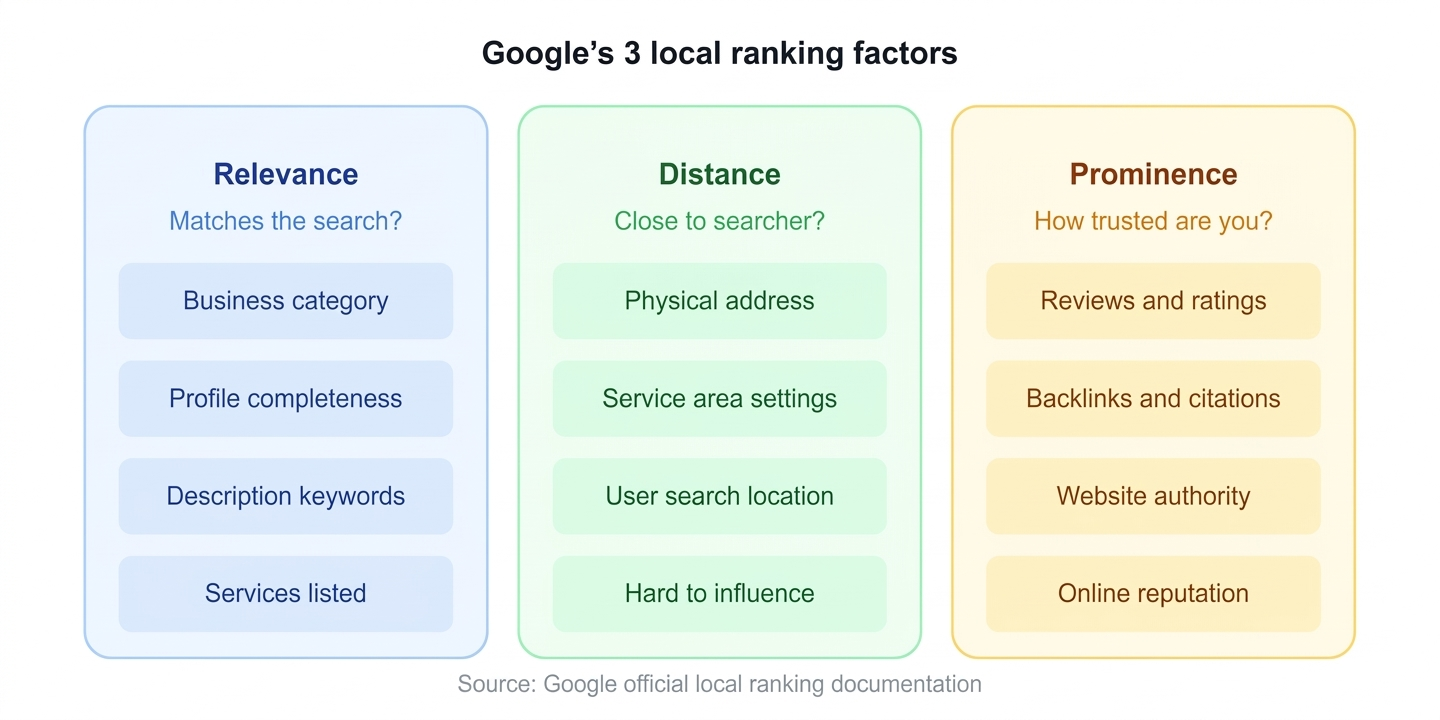
Before you optimise anything, you need to understand how Google thinks. There are no shortcuts here — Google has been transparent about its three core local ranking pillars.
According to Google’s official support documentation, “Local results are based primarily on relevance, distance, and prominence. These factors are combined to help find the best match for your search.”
Simple in theory. More layered in practice. Here’s what each one actually means.
1. Relevance — Does Your Business Match the Search?
Relevance is the most straightforward factor: how well does your business profile match what the user is searching for? If someone searches for a “vegan bakery in Newtown,” Google isn’t going to show them a steakhouse in the CBD, no matter how popular it is.
Your primary business category is the single most important relevance signal. It defines how your business appears in search and which queries trigger your listing.
Getting the category right is step one. Getting it specific is step two. Don’t just pick “Law Firm” — if you specialise, choose “Personal Injury Attorney.” Don’t just pick “Restaurant” — choose “Thai Restaurant” or “Vegan Café.”
2. Distance — How Close Are You?
Distance is probably the only factor you can’t directly influence. You are where you are, and you can neither move your business nor make users search for it from a certain spot.
That said, distance isn’t the whole game. While still relevant, distance has become less dominant — relevance and prominence now carry more weight.
For service-area businesses — think mobile mechanics, cleaners, or consultants — you hide your physical address and define your service areas by city or suburb. This tells Google where you operate without a public storefront.
3. Prominence — How Trusted Is Your Business?
This is where most rankings are actually won or lost. Prominence is your online reputation, authority, and footprint across the web.
Reviews are the digital version of word-of-mouth and a massive signal of trust. Industry data shows review signals can account for over 15% of how you rank in the local pack.
The map pack in 2026 still rewards the basics — categories, proximity, and prominence — but the winners add consistent review velocity, credible web signals, and useful on-profile activity.
Step 1: Claim and Fully Optimise Your Google Business Profile
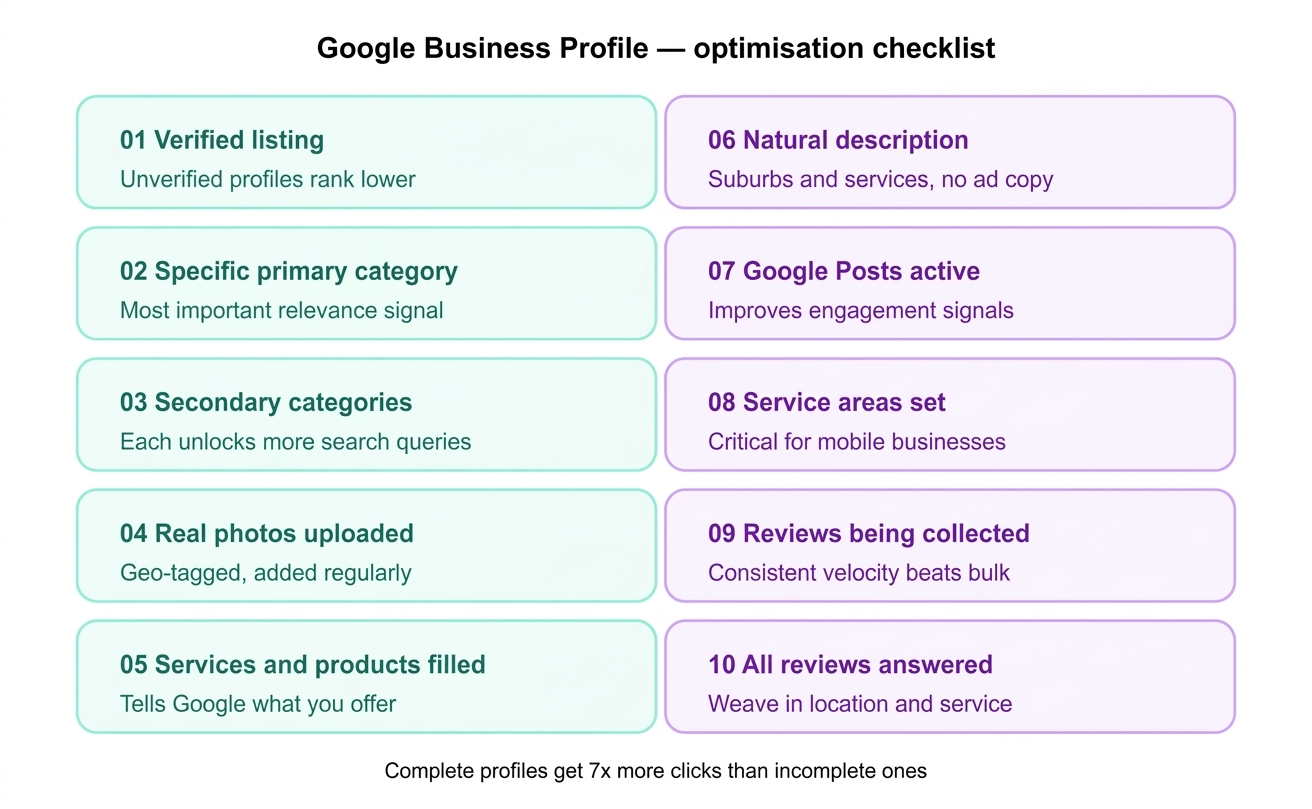
Your Google Business Profile (GBP) is the single most important thing you control. Industry data shows that GBP signals can account for as much as 32% of all map pack ranking factors.
Don’t skip the verification step — an unverified listing won’t rank as well. The rule for optimisation is simple: carefully fill out every line and section you see.
Here’s what a fully optimised GBP looks like:
Business Name: Use your real business name only. No keyword stuffing like “Sydney Plumbers – Emergency 24/7 – Cheap Rates.” Google penalises that.
Categories: Choose a specific primary category and add relevant secondary ones. A café in Sydney might choose ‘Café’ as primary and ‘Breakfast Restaurant’ as secondary. Each category is another search query you can appear for.
Description: Write a natural, informative description that includes your core services and locations. Mention suburbs you serve. Don’t paste your ad copy here.
Photos: Regularly adding new, geo-tagged photos shows Google your business is active and provides fresh content. Upload photos of your team, your work, your premises — real photos, not stock.
Posts: Use Google Posts to share updates, offers, and news. Regular posting with offers, updates, and educational content improves engagement signals.
Services and Products: Fill these out completely. They directly tell Google what you offer and make your profile more relevant to specific searches.
Businesses with complete profiles receive 7x more clicks than incomplete profiles. That’s not a small margin — that’s the difference between thriving and surviving.
Step 2: Get More (and Better) Google Reviews
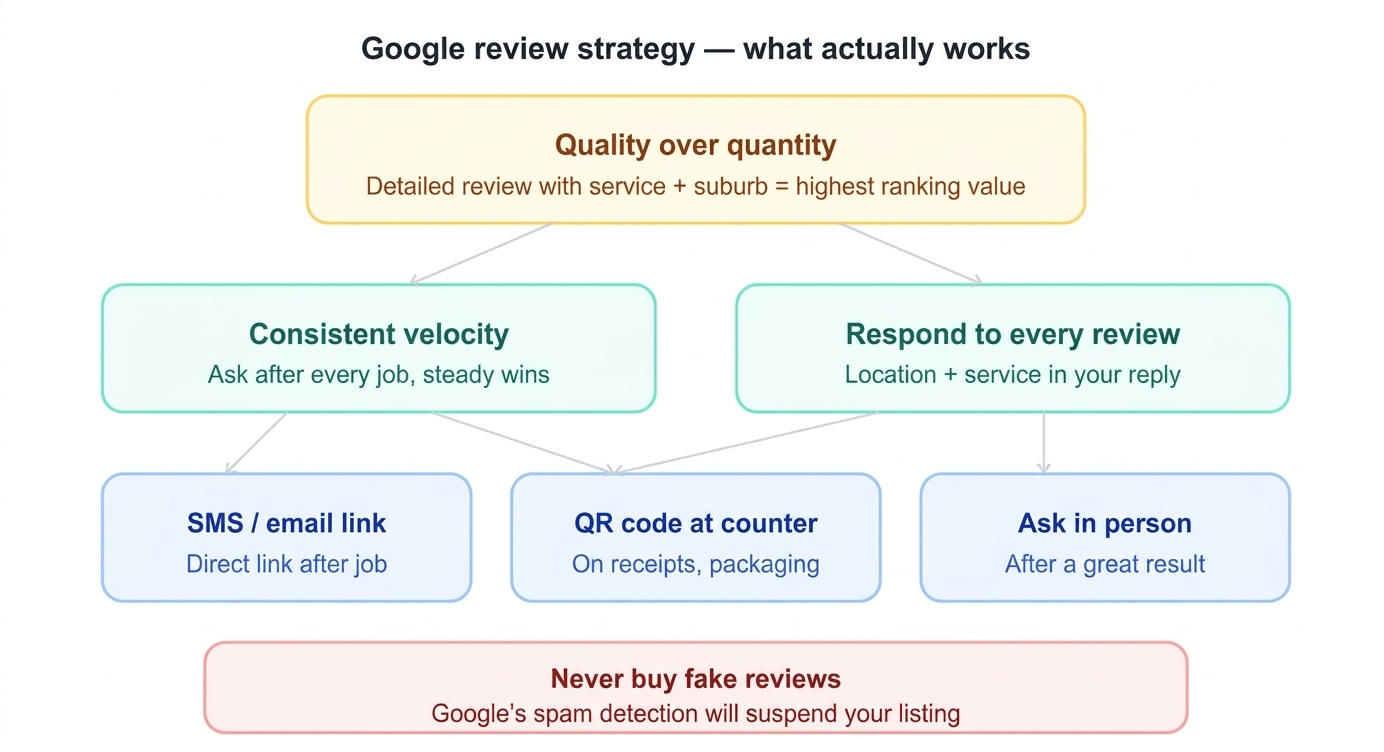
Reviews are where the real ranking battles are fought — and won.
88% of Australians trust online reviews as much as personal recommendations. Combine that with their direct impact on ranking, and you have one of the highest-leverage activities in all of local SEO.
But here’s what most businesses get wrong: they focus on quantity alone and forget about consistency and quality.
Build a daily review request habit tied to closed jobs or visits. Aim for steady cadence over bursts. Encourage specific, photo-aided reviews that mention services and neighbourhoods.
A review that says “Great service from James, fixed our hot water system in Cronulla within two hours” is worth ten times more than a one-star ” Good.”
How to Ask for Reviews the Right Way
- Send a follow-up SMS or email after a job with a direct link to your Google review page
- Use a QR code at your counter, on receipts, or on packaging
- Train your team to ask in person at the right moment — after a great result, not before
Always Respond to Reviews
Reply to every review with specifics. Escalate policy-violating reviews for removal. When responding, you can naturally weave in your service or location — “We’re glad you enjoyed our electrician service in Bondi” — which subtly reinforces relevance to Google.
One hard rule: Never buy fake reviews. Google actively penalises fake engagement through targeted algorithm changes, including the Google August 2026 spam update. It’s not worth the risk.
Step 3: NAP Consistency Across Every Directory
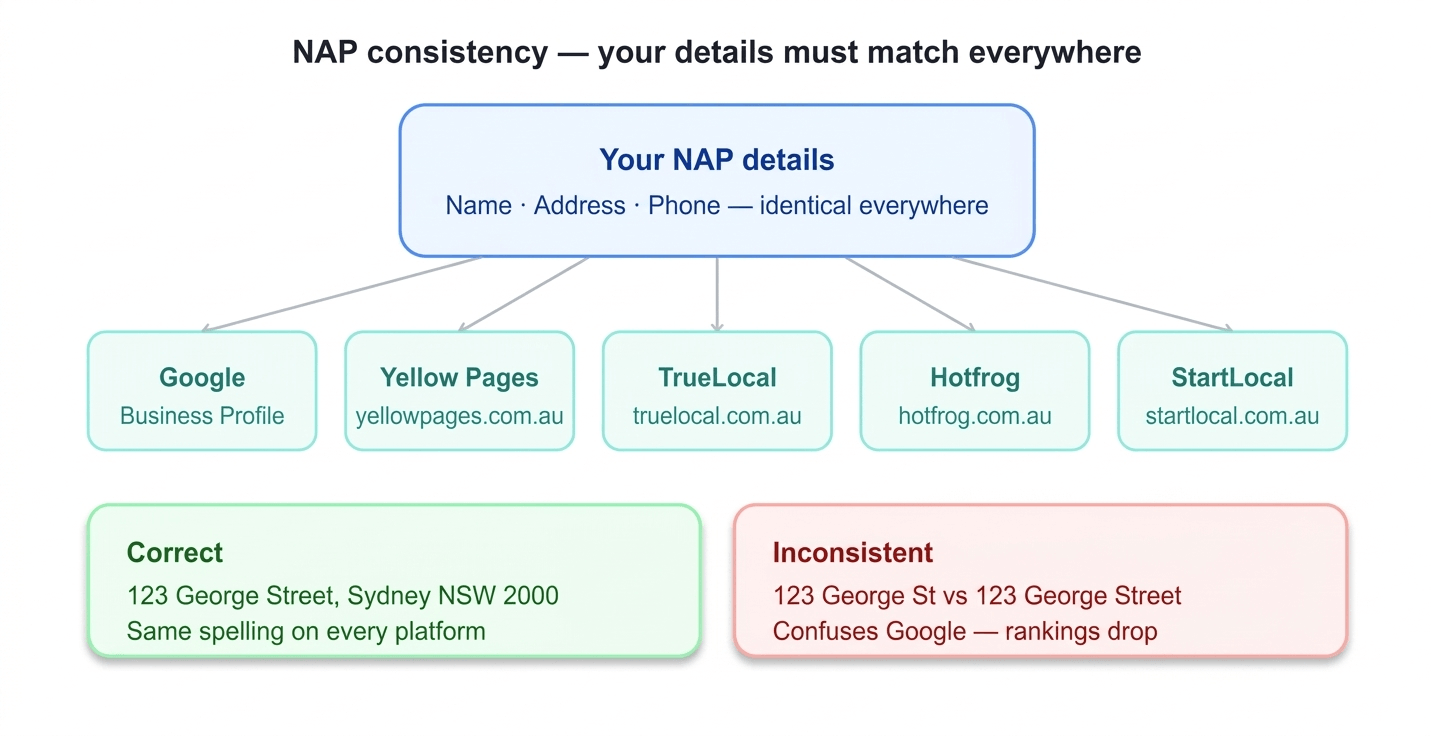
NAP stands for Name, Address, and Phone Number. It sounds boring. It’s actually critical.
Absolute consistency across every single platform is critical. A slight variation — like listing “St.” on one directory and “Street” on another — can confuse search engines and dilute your authority.
Think of NAP consistency as telling the same story everywhere. If Google finds conflicting information about your business across the web, it loses confidence in your listing. And when Google loses confidence, your rankings drop.
For Australian businesses, the most important directories to keep consistent include:
- Google Business Profile (obviously)
- Yellow Pages Australia (yellowpages.com.au)
- TrueLocal
- Hotfrog
- StartLocal
- LocalSearch
- Yelp Australia
Focus on reputable directories like Yellow Pages, TrueLocal, Hotfrog, StartLocal, and LocalSearch. Accurate, consistent business details in these listings build local authority and support Google rankings.
Do a quick audit right now. Search your business name and check every listing you find. Fix inconsistencies wherever they exist.
Step 4: Build a Website That Supports Your Local Rankings
Your Google Business Profile and your website work together. A strong GBP with a weak website is like having a great shopfront over an empty store.
Website authority, as measured by factors like backlinks and overall domain strength, plays a role in local search rankings. A strong website reinforces your business’s credibility and relevance.
Location Pages That Actually Work
If you serve multiple areas, create a dedicated location page for each one. Using location-specific terms like “emergency electrician Brisbane” in your headings, meta descriptions, and page content helps search engines understand which suburbs or cities you serve.
Each page needs to be genuinely useful — not just a copy-paste of the same content with the suburb name changed. Include:
- A unique intro about why you serve that area
- Testimonials from local customers
- A map embed
- Area-specific FAQs
Schema Markup
Add LocalBusiness schema markup to your website. Structured data, such as schema markup, is becoming essential for enhancing search engine understanding of local content. It’s a relatively simple technical addition that tells Google exactly what your business is, where it’s located, and what it does.
On-Page SEO Basics
Make sure your:
- Title tags mention your city or suburb
- Meta descriptions include your primary service and location
- H1 heading is clear and locally targeted
- Footer contains your full NAP details
Step 5: Build Local Backlinks
Backlinks from reputable local websites signal to Google that you’re a legitimate, established business in your area.
One link from a local news site is worth more than 100 low-quality directory listings.
Focus your link-building efforts on:
- Local business directories (chambers of commerce, industry associations)
- Local news websites (many Australian local papers publish business profiles)
- Partner businesses in your area (a tradie who links to a complementary tradie)
- Community sponsorships — sponsor a local sports team, charity event, or school fundraiser and often you’ll earn a mention on their website
Earning links from local businesses, chambers of commerce, or Australian news sources reinforces your credibility in a specific local market.
Step 6: Optimise for Australian Search Behaviour
Australia has unique local search patterns that you need to account for. Local SEO isn’t one-size-fits-all. What works in the U.S. or UK won’t always work in Australia.
Voice Search Is Growing Fast
Australian consumers rely heavily on mobile and voice search to find local businesses — “Plumber near me” or “Thai food open now” are increasingly common voice queries.
Optimise for natural, conversational language. Your GBP description and website content should answer questions the way a real person would ask them.
Reference Local Landmarks and Neighbourhoods
Mention landmarks in your posts — “Just 5 minutes from Town Hall Station” or “Opposite Westfield Bondi Junction.” Talk about local events your business is involved in. Post about seasonal changes: “Winter specials for North Sydney residents.”
This tells Google — and your customers — that you’re genuinely embedded in the local community. Not just a business that happens to have an address there.
Create Locally Relevant Content
A sports store in Melbourne could blog about AFL season prep. A café in Brisbane could write about local weekend markets. A builder in Perth could cover suburb-by-suburb development trends.
Publishing content tied to local events, service areas, or neighbourhood tips improves relevance for geo-targeted local searches.
Step 7: Track Your Rankings and Improve Over Time
Most businesses optimise once and walk away. The ones that dominate local search treat it as an ongoing process.
Google Maps rankings are not permanent — they change based on activity, reviews, and competition. If your profile stays inactive for months, you may slowly drop in rankings even if nothing else changes.
Use these tools to track and improve:
- Local Falcon — shows your Google Maps ranking across a geographic grid, so you can see exactly where you rank suburb by suburb
- BrightLocal — tracks citations, reviews, and ranking positions
- Google Business Profile Insights — shows how many people found your profile, clicked your website, called you, or asked for directions
- Google Search Console — monitors your website’s organic performance
You might discover you rank #1 in your own suburb but only #7 in the next one — even though it’s just 2 km away. That’s an opportunity to focus posts, ads, and offers for that specific area.
Common Mistakes Australian Businesses Make on Google Maps
Let’s be honest — most businesses are making at least one of these mistakes right now.
Duplicate listings: Having more than one profile for the same location confuses Google and can actually hurt your ranking. Merge or remove duplicates immediately.
Keyword stuffing in the business name: Adding keywords like “Best” or “Cheap” to your GBP business name is a direct violation of Google’s guidelines. You risk suspension.
Ignoring negative reviews: A negative review left unanswered tells potential customers you don’t care. Respond quickly, professionally, and with empathy.
Setting wrong categories: Being too broad (“Business”) or slightly wrong (“Restaurant” instead of “Café”) means you miss relevant searches entirely.
Buying fake reviews: Already mentioned, but worth repeating. Google’s spam detection is sophisticated. The short-term gain is never worth the long-term penalty.
How Long Does It Take to Rank on Google Maps in Australia?
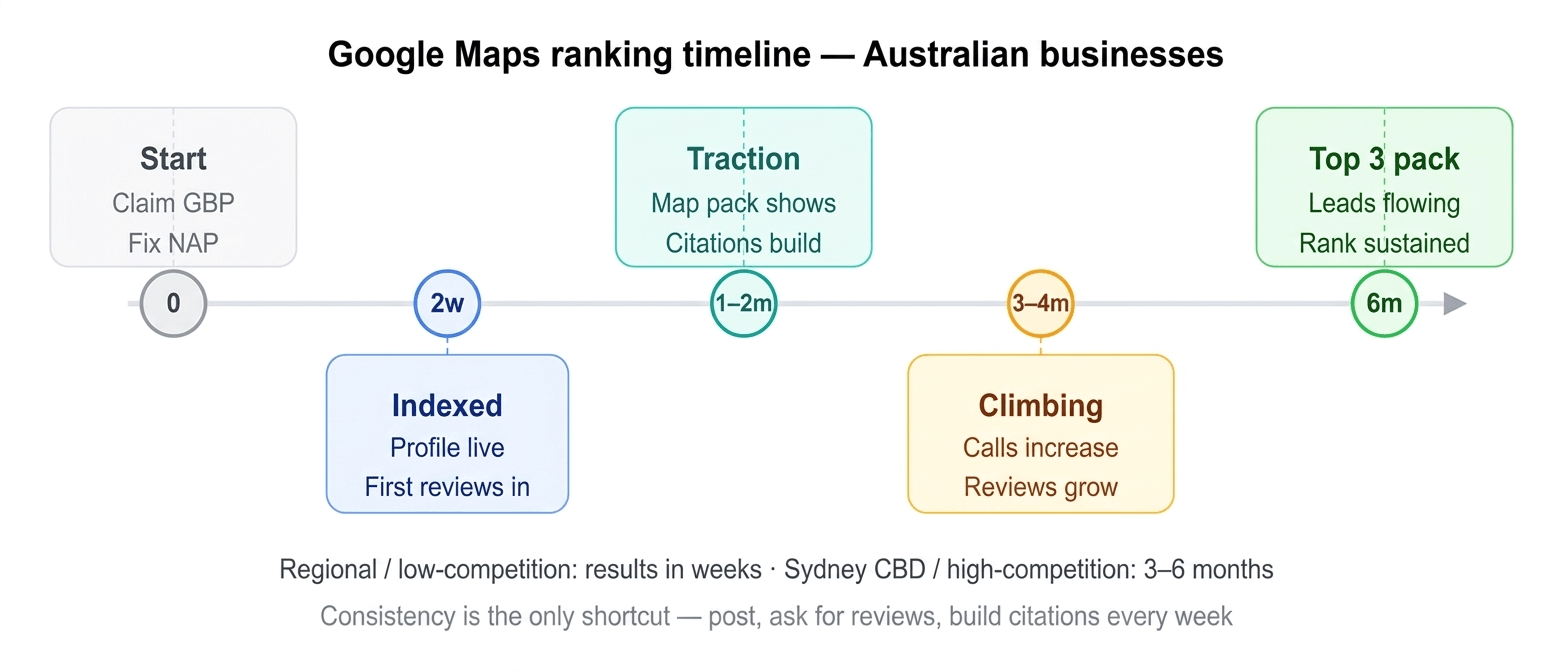
Here’s the honest answer: it depends on how competitive your market is.
For a low-competition niche in a regional Australian town, you might see results in weeks. For a highly competitive category in Sydney’s CBD, expect 3 to 6 months of consistent work before you see meaningful movement.
Local SEO is a marathon, not a sprint. Implement these strategies consistently over 3 to 6 months, and you’ll see significant improvements in rankings, traffic, and most importantly, revenue.
The businesses that win are the ones that stay consistent — posting regularly, asking for reviews every week, fixing citations, and creating fresh content. Momentum builds over time.
Should You Hire a Local SEO Agency in Australia?
Basic optimisation — setting up your GBP, gathering reviews, fixing citations — is something many business owners can handle themselves.
But a comprehensive local SEO strategy takes time, expertise, and ongoing effort. For a comprehensive strategy, partnering with a local SEO agency in Australia is more effective.
A good Australian local SEO agency will understand:
- The local directories that matter in your market
- Suburb-level ranking strategies for your city
- Australian consumer search behaviour
- How to track results and adapt quickly
When evaluating agencies, ask for case studies from Australian businesses in your industry. Ask how they measure success. Avoid anyone promising guaranteed #1 rankings — no one can guarantee that. Google’s algorithm is Google’s.
Google Maps SEO Checklist for Australian Businesses
Use this as your starting point:
- Claimed and verified your Google Business Profile
- Filled out every section of the GBP completely
- Chosen a specific, accurate primary category
- Added relevant secondary categories
- Uploaded real photos (and adding new ones regularly)
- Set up your service areas (for SABs)
- Consistent NAP across all major Australian directories
- Actively requesting reviews after every job
- Responding to every review
- Location pages on your website for each area you serve
- LocalBusiness schema markup on your website
- Building local backlinks from relevant Australian sources
- Tracking rankings with Local Falcon or BrightLocal
- Publishing regular GBP posts
- Creating locally relevant content on your website
Final Thought
Ranking #1 on Google Maps in Australia isn’t about gaming the system. It’s about being genuinely useful, consistently active, and building real trust — both with customers and with Google.
The businesses at the top of the Local Pack in every Australian suburb didn’t get there by accident. They got there by doing the fundamentals well, showing up consistently, and never treating their Google presence as a “set and forget” task.
Start with your Google Business Profile. Get your NAP consistent. Ask for reviews after every job. Build from there.
That’s it. No magic. No tricks. Just local SEO done properly — and done consistently.
Frequently Asked Questions
Contact The Creative Warrior Team
Recent Posts

How to Add Creative Warrior to Your Google Business Profile
If you would like to add Creative Warrior to your Google Business Profile as a [...]

SEO for Real Estate Agents Perth | Creative Warrior
Website Design Trends 2026: What Small Businesses Should Know Perth's [...]

My Honest Advice for Startups Choosing Between DIY and Professional Marketing Help
Starting a business is exciting, but it can also be incredibly overwhelming. There are so [...]

Why Most Small Business Websites Don’t Convert — And What No One Tells You
A beautiful website is not the same thing as an effective one. That is [...]

3 Lessons I’ve Learned Helping Burnt-Out Business Owners Fix Their Websites
Over the years, I’ve worked with many small business owners around Perth who feel [...]

Why Your Business Isn’t Ranking in Perth (And How to Fix It)
How Google Reviews Help Tradies Win More Jobs You built [...]

How to Rank in Google AI Overviews (Step-by-Step)
How Google Reviews Help Tradies Win More Jobs TL;DR: Google [...]

How to Rank #1 in Google Maps in Australia (2026 Guide)
How Google Reviews Help Tradies Win More Jobs You open Google [...]


